

Naoya Oshima creates paintings that question the relationship between image and reality through the reconstruction of photographic fragments.
Using printed photographs as material, he cuts and reassembles visual images, destabilizing the boundary between the real and the fictive within the painted surface. These fragmented compositions emphasize the fictional nature of images while paradoxically generating a strong sense of reality.
His motifs often include traditional Japanese imagery such as cherry blossoms and bonsai. Rather than simply reproducing them, he reconfigures these familiar images to create new meanings, activating collective visual memory and prompting viewers to reconsider how a sense of “reality” is constructed.
In his recent “Yoizu Genjō Mosha (Pseudo-Documentary Copies of Supernatural Illustrations)” series, Oshima depicts non-existent picture scrolls and archival materials as if they were historical artifacts. By incorporating motifs such as yokai and supernatural beings, and rendering traces of aging—stains, creases, and deterioration—he produces works that appear to have existed over time, despite being entirely fictional. Through this strategy, he explores a distinct sense of reality that emerges between imitation and disclosure.
In an era where the boundary between reality and fiction continues to blur, Oshima investigates how the act of painting can reclaim a tangible sense of presence.
Born in Gifu, Japan in 1995. He received his PhD in Fine Arts from Tokyo University of the Arts in 2024. He has received awards including the Grand Prize at the Hida Takayama Garou Sakura Nihonga Award and continues to exhibit widely in Japan.
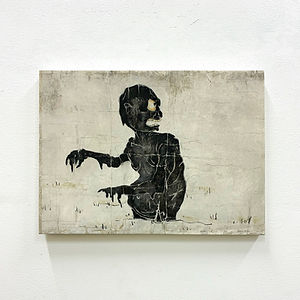
Facsimile of a Nonexistent Yokai Archive #6 / Something Diving, 2026
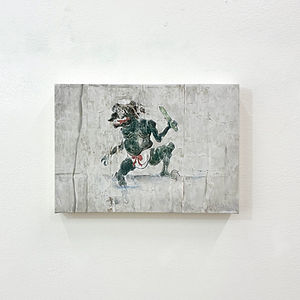
Facsimile of a Nonexistent Yokai Archive #1 / Joyful Appearance, 2025

Picture Arrangement
/Shakuyaku, 2025
