
Kisho Kakutani
Kisho Kakutani × Shuya Tajiri
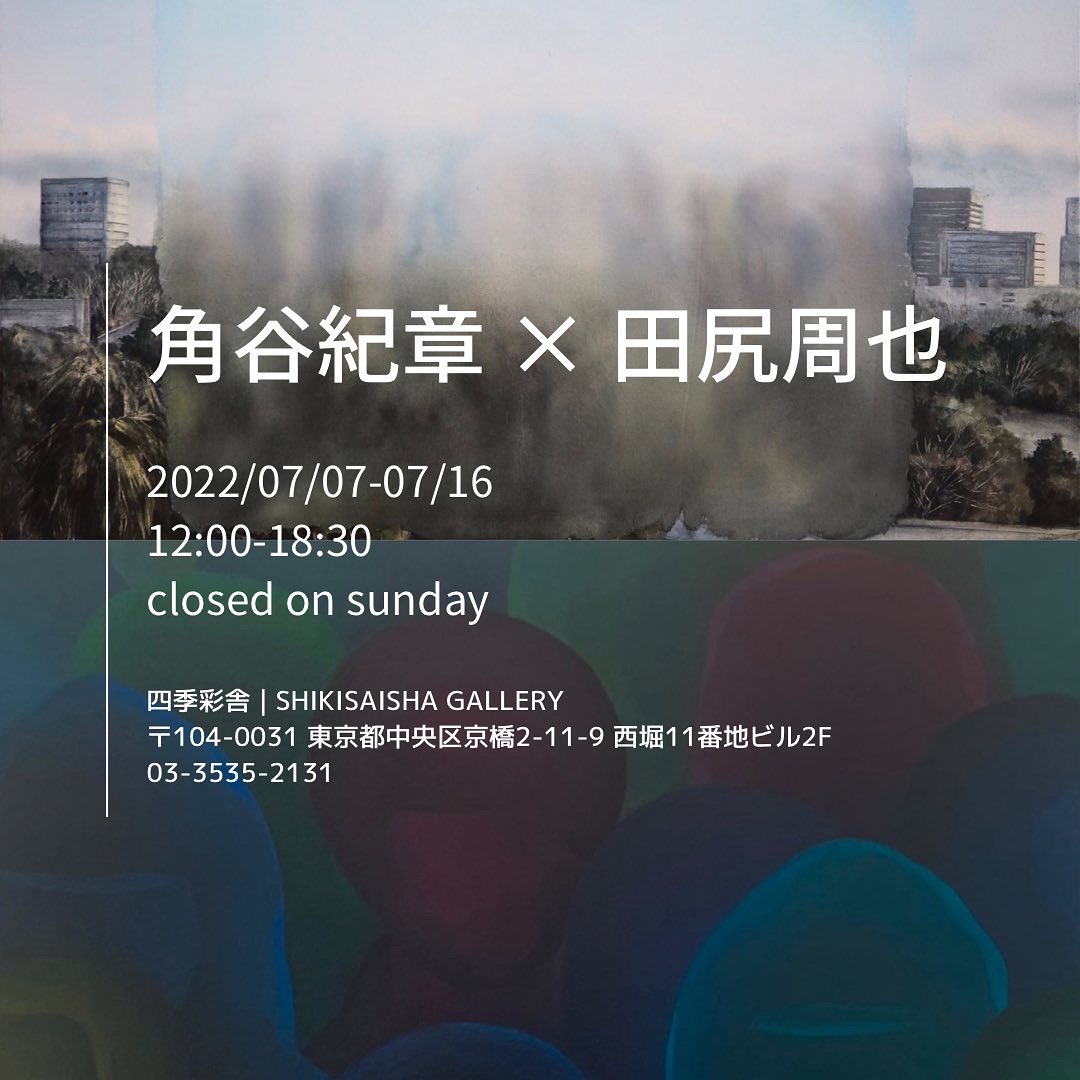
Kisho Kakutani makes work with the aim of prompting others to imagine.
In his “Frosted Window” series, inspired by views through frosted glass, he places visual noise at the center of the image to interrupt the viewer's perception. By inviting viewers to imagine the scene beyond that noise, he draws them into the world of the painting.
The views within the frosted-glass areas are based on smartphone snapshots, drawing on the blur and camera shake captured in those images.
Based on these photographs, the works are made by allowing ink to soak into a cotton support. Although they may look as if they have been blurred afterward, every element, including the noise, is painted during the process.
The extensive use of water produces chance effects. Kakutani then imagines the surrounding landscape in response to the scene within the frosted-glass area, adding it afterward in mineral pigments.
Shuya Tajiri explores the abstract nature of human existence.
Born and raised in Tokyo, he says that, since childhood, people have appeared to him to flow impersonally through the city.
His groups of figures express his inner world, but do not readily welcome the viewer.
By imbuing his paintings with the unease and curiosity of an encounter with another person, he sustains a certain tension between the viewer and the work. Through this, he seeks to reconsider the abstract nature of how people and paintings exist.
Please contact us here if you would like a list of works.
Kisho Kakutani × Shuya Tajiri
July 7–16, 2022
12:00–18:30
Saturdays until 17:30
Closed Sunday
Kisho Kakutani
Kisho Kakutani (b. 1993, Kobe, Hyogo, Japan) completed his PhD in Japanese Painting at Tokyo University of the Arts in 2022. Using everyday snapshots taken with his smartphone as source material, he creates paintings that explore the ambiguity of memory and visual perception. In series such as *Frosted Window* and *Curtain*, Kakutani deliberately obscures parts of the image with visual noise resembling frosted glass or curtains, inviting viewers to complete what is unseen through their own memories and imagination. His practice reconsiders the act of seeing in an age of visual overload, positioning painting as a device for generating new images within the viewer’s mind.
Kisho Kakutani (b. 1993, Kobe, Hyogo, Japan) completed his PhD in Japanese Painting at Tokyo University of the Arts in 2022. Using everyday snapshots taken with his smartphone as source material, he creates paintings that explore the ambiguity of memory and visual perception. In series such as *Frosted Window* and *Curtain*, Kakutani deliberately obscures parts of the image with visual noise resembling frosted glass or curtains, inviting viewers to complete what is unseen through their own memories and imagination. His practice reconsiders the act of seeing in an age of visual overload, positioning painting as a device for generating new images within the viewer’s mind.


